09 430 3406
 administrator@tiaho.org.nz
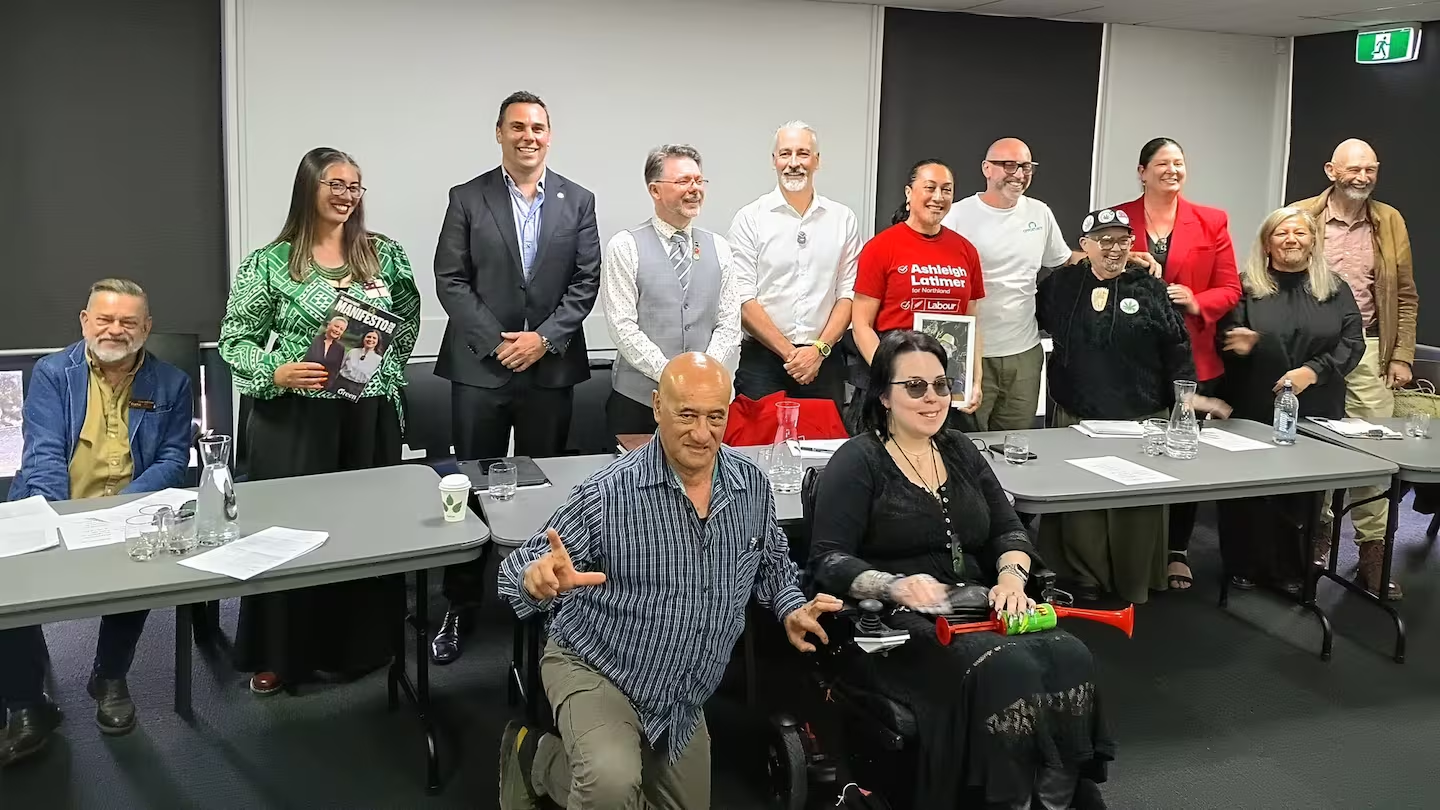
There is something slightly unnatural about putting a group of politicians in a room, giving them a microphone, and then expecting them to stick to three questions.
Nevertheless, on Tuesday, Tiaho Trust, in collaboration with DPA, did exactly that at Forum North for our disability focused Meet the Candidates event.
This was the fourth time Tiaho has held one of these events. You might think that after three elections we would have solved all the problems facing disabled people by now. Strangely, accessible housing remains scarce, rural services remain difficult to access and disability support continues to provide plenty of material for the fourth event.
Every candidate standing in the Whangārei, Northland and Te Tai Tokerau electorates was invited.
Some were noticeable by their absence.
Those who did turn up faced three questions: Where does your party stand on the new Disability Support Services legislation? What will you do about accessible and affordable housing in Northland? And how will you address the additional costs and barriers facing disabled people in rural and remote communities?
Unsurprisingly, complete political harmony did not break out.
The DSS legislation produced the sharpest divisions. National’s Lloyd Budd defended the Government’s approach, while NZ First’s Vince Cocurullo supported having a legislative framework while acknowledging concerns about it.
Labour’s Dr Gary Payinda, Ashleigh Latimer and Willow-Jean Prime were strongly critical, as were Hūhana Lyndon of the Greens, Simon DellaBarca of Opportunity and Mariameno Kapa-Kingi of Te Tai Tokerau Party.
Despite those differences, there was considerably more agreement on one thing: being disabled in Northland can be unnecessarily difficult.
Accessible housing is woefully inadequate. DellaBarca talked about universal design building accessibility in from the beginning instead of paying considerably more to retrofit it later. Others talked about social housing, accessible housing commitments and locally led solutions.
Then there is the tyranny of distance.
Living rurally with a disability can mean travelling considerable distances, finding accessible transport and paying costs somebody in a major centre may never contemplate.
Cocurullo made the point that disability shouldn’t become harder the further you live from Wellington.
Unfortunately, sometimes government services seem to operate on the assumption that civilisation ends somewhere around the Bombay Hills.
But the most powerful part of the morning came when we put aside our carefully prepared questions and handed the microphone to the audience.
One parent described the lack of suitable respite care for teenagers in Whangārei and being told a rest home could be an option for her teenage daughter.
Just let that sink in.
Another mother had moved to Northland with her severely disabled daughter. Her daughter’s disability hadn’t changed. Her needs hadn’t magically diminished while crossing a regional boundary. Yet following reassessment, the family’s respite support was reduced.
Whatever your politics, there is something fundamentally wrong when crossing an invisible line on a map can substantially change the support available to a disabled person and their whānau.
These aren’t theoretical policy debates. They determine whether somebody can get out of bed in the morning, whether a parent gets a desperately needed night of respite, whether someone can afford to get to an appointment and whether a young disabled person has somewhere appropriate to go to for respite care.
One message kept surfacing: involve disabled people in decisions about our lives.
Revolutionary stuff, I know.
Election campaigns give politicians countless opportunities to tell us what they are going to do for us.
For one morning at Forum North, we reversed the microphones.
We told them.
Credit to the candidates who turned up and faced the questions, to DPA, our NZSL interpreters and my staff who made the event accessible and especially to the disabled people, parents, carers and whānau who spoke up.
Candidates may disagree considerably about how to fix the system.
But the candidates who came along certainly can’t say they weren’t told, directly and clearly, what disabled people and their whānau need.
And for those candidates who couldn’t or chose not to be in the room, the livestream video is still sitting on the Tiaho Trust Facebook page. So there is still time to listen.
After all, listening to disabled people shouldn’t only happen when there’s an election looming.
And if all else fails, there’s always our fifth Meet the Candidates.
This article has been previously published in the Northern Advocate